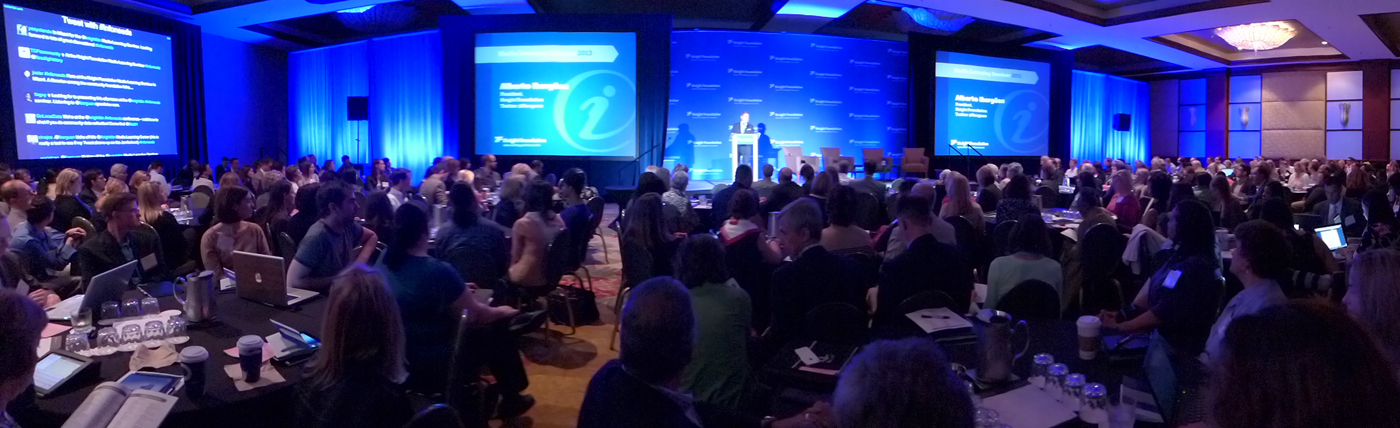
Expanded commitment to community information needs
Today in Miami, we at Knight Foundation are renewing our commitment to helping community and place-based funders meet their local community information needs. For the next three years, we’ll be both expanding and tailoring the Knight Community Information Challenge, which provides funding and the expertise needed for the foundations to invest in media projects that help ensure communities are informed and engaged. Related LinkS
“Going from sustainability to thrivability: success stories from Sundance, The Texas Tribune and KCRW” on KnightBlog
“Community foundations share moments of truth” on KnightBlog
“How human-centered design can transform community media” on Knight Blog
A Storify: Media Learning Seminar 2013: Day One on KnightBlog
“In first public comments since plagiarism scandal Jonah Lehrer blames ‘arrogance, need for attention’ for lies” on KnightBlog
When we launched the challenge five years ago, we did it based on two beliefs – or, perhaps more accurately, one passionate belief, and one notion.
The passionate belief was our bedrock principle that a well-functioning democracy depends on the free flow of news and information. The notion was that the changes sweeping the media landscape – many of them driven by new, disruptive technologies — created both a need and an opportunity for foundations to step up, to play a bigger role in providing citizens with the information required to engage in civic life.
Over the past five years, the notion has been affirmed unequivocally, and many times over.
In communities large, medium, and small — scattered from Miami to Maine to Southern California, the Pacific Northwest and places in between – foundation leaders have embraced their leadership role in creating the informed citizenry that is a prerequisite for a well-functioning democracy.
Whether it’s responding to wildfires in Arizona, locating affordable housing in Washington, D.C., or fighting predatory lending along the Gulf Coast – challenge winners are, in myriad ways, affirming that people and communities live safer, healthier, and better lives when they’re well informed. You can read further about the impact of their efforts in a new report we published this week, in partnership with FSG and Network Impact.
We believe we are building a movement. But we are still in the early innings of this game. There is much left to do.
That’s why we have decided to extend our efforts in four ways through 2015:
- Tailored seed funding for information projects: While we are eager to continue funding experimentation, the contest will evolve somewhat. We will continue to have an open contest but will also provide a second track to seek out projects in areas that we find particularly timely, relevant and impact, for example in the mobile or open government space.
- Expanded technical assistance: We’re increasing the numbers and skill base for our team of consultants that we call Circuit Riders, so that they can help foundations no matter what phase of the project they are in. The Knight Digital Media Center at the University of Southern California also will offer skills training tailored to funders.
- Learning Networks: We will be applying what we have learned over the last five years to make some more pointed investments in the projects that have worked best. We will invest more in some of our proven early adopters, and in return we will ask them to share what they have learned with their peers.
- Media Learning Seminar: We’ll also continue the annual winter gathering in Miami, taking place today and tomorrow, which has become the place for foundations to explore trends and share learnings. (You can watch the livestream here.)
As we begin the next chapter of the Knight Community Information Challenge, let me conclude by saying that our intention is not to simply sift through whatever ideas float in over the transom. Our intention is to actively seek out the best ideas and support them, wherever they may be.
We’re very pleased with what the Community Information Challenge initiative, and what we have accomplished together over the last five years. We need only look around the crowd at this week’s Media Learning Seminar to see that what began as a notion – the idea that community and place-based foundations had an important role to play in creating a better informed and more fully engaged citizenry – is now a fact.
By Alberto Ibargüen, President of Knight Foundation
Recent Content
-
 Communitiesarticle ·
 -
 Communitiesarticle ·
 -
 Communitiesarticle ·