Knight Foundation

Informed & Engaged Communities

Knight Blog

The blog of the John S. & James L. Knight Foundation

Do universities hear the critics of journalism education?

March 17, 2013, 8:49 a.m., Posted by Eric Newton – 19 Comments


Remember the scene from the movie Annie Hall, when everyone is in the theater line? An academic blowhard misquotes media scholar Marshall McLuhan. Woody Allen protests. Retorts the prof: “I happen to teach a class at Columbia… my insights into Mr. McLuhan have a great deal of validity… .” Says Allen: “Well, that’s funny because I happen to have Mr. McLuhan right here.” And into the frame walks Marshall McLuhan himself. He looks the prof right in the eyes and says: “You know nothing of my work … how you got to teach a course in anything is totally amazing!” Muses Allen: “Boy, if life were only like this.”

Unfortunately, life isn’t like that at all. And so it was the other day when the provost at Indiana University announced she was going to “improve” the university’s award-winning School of Journalism by running it out of Ernie Pyle Hall and mashing it into the College of Arts and Sciences where the scholars in charge will have their way with it.

The provost said the journalism education reform we’ve been writing about was part of the reason for change. Yet from all appearances, she knows nothing of our work.

We’ve argued journalism education needs to grow. At Indiana, the discussion is about attrition. We think journalism education should become more important. At Indiana, the school is losing independence.  Journalism schools should be nimble. At Indiana, they’re increasing the layers of decision-makers. We say top professionals should be equal  to scholars. They’ll bury the pros in a college run by scholars.

Is “reform” being used as a political excuse to demote the school? Why? Indiana isn’t tiny. It’s in the upper half of independent schools in terms of financial resources. Its writing quality is high, with its students winning Hearst Journalism Awards. It is weaker in broadcast and digital media (just look at the web site). That said, inventing the future of news can’t possibly be achieved by mashing the larger standalone schools into someone else’s college. It will come when leaders desire – as the president and deans have done from Arizona State University to New York’s Columbia University – to take a good school to a higher, greater level. The changes I’ve been describing, including a professional doctorate, are not what’s being discussed at Indiana.

This brings up a bigger issue. Is journalism education getting the message?  We’ve been talking about  four “transformational trends.”  Great journalism schools 1. connect with the rest of the university; 2. innovate with digital tools and techniques; 3. master more open, collaborative approaches,  and become not just community information providers, but  “teaching hospitals” that inform and engage their communities.

Is that message getting through? The first reaction was: We’re doing it! But then schools showed us journalism with no engagement, which is pretty much like hospitals with doctors and medicine but no patients. When we explained, the second reaction was: We can’t do all this! If we teach gizmos, we can’t teach journalism. Wrong again. To teach journalism in the digital age you have to teach both journalism and the digital age -- and use modern tools to do it. That’s why the schools that are serious about this are getting bigger, not smaller.

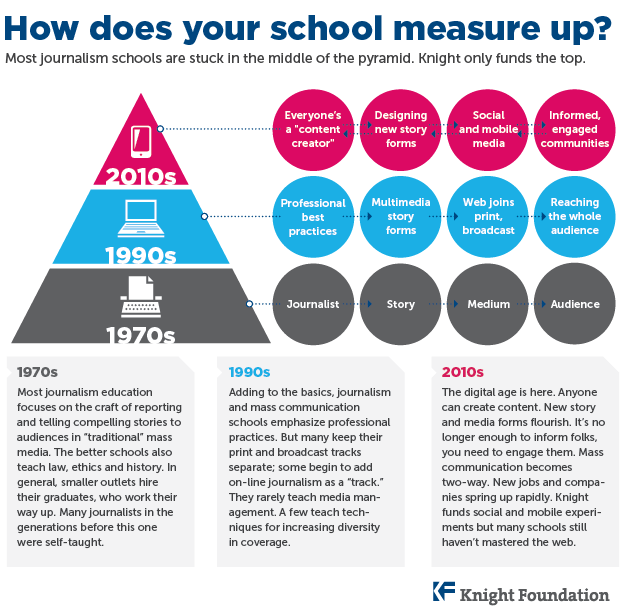
Let’s try the message again, this time with a graphic. Atop this blog you see three layers of journalism education, from craft training to professional education to the new, networked world.

You get to the top by doing each level well and continuing to move higher. Few schools have made it to the top. But some are doing great things. Teaching digital media literacy to a whole community. Teaching news literacy to 10,000 freshmen and sophomores. Team-teaching new app classes with engineers. Offering joint journalism-computer science degrees. Educating entrepreneurial journalists. Being the most important source of information and engagement in their communities.  Some of that is described in the report on the Carnegie-Knight Initiative for the Future of Journalism Education.

Can journalism education keep up, with the ground shifting under it, with word people who need to become numbers people, with the bloodsport of developing new classes, with a lack of appreciating for professionals? How will it all come out?

On the one hand, journalism education leaders have rewritten accreditation standards into the digital age. They seem to want to track reform with improved surveys of programs and graduates. They are looking to the future at leadership meetings. On the other hand, j ed hasn’t coped with mobile and social yet, and now Google is coming out with media glasses. New techniques and technologies are born monthly and it takes two years to get a new class through. Major new forms of media arise in less time than it takes to get a PhD.

I doubt academia will handle the digital age well. It still hasn’t accepted that this is the biggest leap since Gutenberg conjured the age of mass media with movable metal type. Yet an America with fewer than 500-plus journalism programs would be just fine with me, so long as they get better. As Jason Robards (playing Ben Bradlee of the Washington Post) said in the movie All the President’s Men: “Nothing’s riding on this except the First Amendment of the Constitution, freedom of the press and maybe the future of the country …”

What kind of journalism school will Indiana become? The interim dean reports the provost wants it to be “breathtaking.” If she restores independence, shifts the unproductive people (including scholars) to other programs, rewrites promotion and tenure rules, builds a new digital facility, hires the best people and totally revamps everything that’s taught – boy, if life were only like this -- well, that would be breathtaking

By Eric Newton, senior adviser to the president at Knight Foundation

Comments

March 17, 2013, 11:18 p.m.

Megan

Thank you, thank you, thank you for writing this! As a 2009 graduate of the Indiana University School of Journalism, I'm deeply concerned about what's happening to the program, and I feel the only thing that may cause the administration to reconsider this impending mistake is to hear how professionals in the industry will view the program--and the value of its graduates--if this merger happens.

March 17, 2013, 11:42 p.m.

John R. Fulton Jr.

Right now Indiana University's School of Journalism has one foot in the grave and the other on a banana peel. I went to Indiana and won one of those Hearst gold medals. But I really won it for Indiana University. I would hate to think it was for nothing. Thanks for your thoughtful article.

March 18, 2013, 1:41 p.m.

Shawn Steel

The struggle among the academics is like watching sfeeding frenzy with hyenas.

So what iif the journalism department is independent or not? What independence ---certainly not concerning diverse political views

Well over 90% of all tenured professors are servants of the Left

If students of journalism have a meager future it is because the public is wary of the constant propaganda

March 18, 2013, 3:53 p.m.

Pat Esgate

Class of 1973 here, and thanking you for your coverage of this travesty. But you missed one of the best quotes: the president of the University telling the local paper, “There’s no point in saving a school that trains people to manage fleets of horses if the motorcar has taken over horse-drawn transportation.”

Journalism is not "mass communication", blaring BS to a large group of barely interested people. Journalism is not "media”, a product to be monetized. Journalism is the thoughtful reporting of events, delivered with balance, allowing readers to form their own opinion. Journalism informs and inspires, through the facts presented.

Bigger is not better. The fact that this is happening, at a time when the world needs better reporting, not less, is a tragedy.

March 18, 2013, 6:05 p.m.

Meghan Dwyer

BAJ'05 JD'08. Thank you for publicly taking the Provost to task. If Ernie Pyle gets swallowed by COAS it's going to lose much more than donor money.

March 18, 2013, 9:27 p.m.

Erika Lee

Truthfully, no one here at IU seems to be too upset about merging the programs and many think it will be good for the students, who often have to try to straddle these departments to take the classes they want to. It's the loss of independence that is most worrisome. The College is unlikely to promote folks based on good teaching, excellence in the field and so on the way an independent school can, and folks are worried that the professional aspects of the school will be swallowed up and probably with good reason. If anything, in my opinion, they should be talking about the J-School working more closely with Informatics, but that doesn't seem to be part of the discussion. Thank you for writing about this.

March 19, 2013, 2:38 p.m.

Joel Beeson

Being independent is extremely important, but so is being nimble and able to innovate. I don't understand the argument for more focus on professionals from the industry, because in my experience, many are disgruntled former journalists who are bitter about losing their jobs to the new digital media. As a former print photojournalist, editor and early adopter of ITCs, who went on to get a doctorate (NOT in journalism, but in communication), I am an advocate for "public scholarship." This combines project-based, community-engagement learning, diversity, technological innovation and critical scholarship. So the professional/academic binary argument just doesn't fit IMHO. Why not take the values we hold so dear in journalism ("truth"– whether empirical, situated, contested, and holding our political leaders and institutions accountable, strengthening democracy, etc) and intelligently engage in experimentation and innovative research? Criticizing journalism research conventions and paradigms is one thing; advocating that journalism schools jettison scholarship and research for skills-based curricula is another. And ill-advised.

March 19, 2013, 6:45 p.m.

Sally Lehrman

I've been working diligently to connect our undergraduate students and student work to local news enterprises. Last quarter I built in an editing component so that a small group of students also can learn to edit outside of the normal classroom structure. I like the model but I wish the news enterprises would find a better way to give back to the universities. Small grants to help pay for editing time, say, or even modest payments to students whose work gets published.

March 20, 2013, 9:56 p.m.

Karl Idsvoog

To improve journalism education, I would urge the Knight Foundation to award several full scholarship awards to student journalists who do first-rate reporting that holds their universities accountable. But to submit, require a sponsoring a professor.

Too many universities are afraid of journalism. They don't want their students asking questions and pressing for answers. For journalism education to improve, that needs to change.

Across the country, we've witnessed one college athletic scandal after another. The cause can be summed up in two words: university ethics.

I would urge people to watch this wonderful challenge to university faculties from Jon Ericson, the founder of the Drake Group, an organization concerned not with raising money or the president's salary or the new football stadium, but with academic integrity.

https://vimeo.com/39764531

His challenge provides student journalists a great story. What is their university provost doing to make sure the university hasn't turned into an eligibility mill for athletes? Ask for evidence. Request the analysis and reports done to examine the issue. A university concerned about academic integrity will have such an analysis. That's what Jon Ericson did. What is your university provost doing?

Remember: when journalism fails, bad things happen.

March 22, 2013, 1:56 p.m.

Steve Outing

The problem with getting universities to change in the direction that Eric, Knight, and other journalism funders are seeking is probably well represented by CU-Boulder. This is all public record, so I’m sharing no inner secrets. Here’s the timeline of attempted change at CU Journalism:

In 2009, a College of Information Task Force, consisting of deans and community stakeholders, began exploring whether it should merge the journalism school with CU’s ATLAS Institute (a then-independent campus digital-media center) and some form of computer science. The task force released its report in April 2010 recommending a College of Information, but it was not well received by CU administrators. ...

In August 2010, an exploratory committee was formed to consider the structure and organization of a new interdisciplinary academic ICT (information, communication, technology) program. At the same time, the process for “discontinuation” of the JMC School was begun. ... Next: CU’s J-school dean resigned in June 2011, at the same time that the J-school was “discontinued” by the CU Board of Regents; the school became a “program” temporarily part of the School for Graduate Studies. An interim director with no journalism or media background was appointed, who was asked to oversee the J program for 2 years, when Journalism & Mass Communication presumably would move to become part of a newly formed college based on ICJMT (information, communication, journalism, media, technology). ...

Next: A faculty ICJMT steering committee was formed to create a new, better plan for a new college. That group produced an ambitious proposal involving combining many disciplines, under the proposed name of a “College of Media, Design & the Arts.” Their report was published in April 2012. ... Next: The Provost invited an external review team of scholars to spend a week on our campus in early 2013; speak with stakeholders; and review the ICJMT committee’s report. The visitors’ report was published March 2013 (this week). http://www.colorado.edu/news/features/icjmt-external-review-report-now-available ... The provost’s introductory letter for the external review team’s report notes that the report will become part of the “ongoing conversation about how we should move forward in the general areas of information, communication, journalism, media, and technology.”

So, problem recognized and first serious effort at restructuring journalism and related fields for the digital age begins in 2009. Now it’s March 2013, and we’re still in “ongoing conversation” stage. As for JMC, it moves into a 3rd year of being overseen by an interim director; that could stretch to a 4th year.

(continued in next comment)

March 22, 2013, 1:57 p.m.

Steve Outing

(part 2 of comment)

Anything further I could say would go beyond the public record. But anyone can read the situation and realize that a new college and home for Journalism at CU is probably still years off.

Leaders of CU and of CU JMC are well versed in what Eric and his fellow journalism funders are advocating. Eric visited JMC faculty and CU's chancellor last summer. I don’t have personal knowledge of what our chancellor, provost, and other administrators think of Eric and Knight’s view of j-education reform. But if I presume that they agree 100% (unlikely), it’s looking like it will take at least 6 years to get to the point of implementation of j-education reform that addresses what Eric is getting at in this and his other posts about j-education..

Anyone got ideas on how to speed things up in situations like CU’s? I’m sure that the situation here is hardly unique.

March 24, 2013, 4:16 p.m.

Andria Krewson

Steve Outing just wondered aloud on Twitter why he hasn't seen more conversation about this issue.

From what I've seen, most schools and academics are too busy changing their class content and events to take time out to argue about whether they're changing fast enough. The rise of digital branding, integrated marketing and digital PR are presenting plenty of opportunities for faculty and students. Going digital isn't the hard part; keeping a focus on *journalism* is.

For civic, accountability journalism, the picture is dark, with student media organizations in particular seeing their business models evaporate. News or civic journalism departments can't dangle the future digital jobs that PR and marketing departments can for students. State legislatures are asking colleges to align education with particular jobs that industry needs to fill. Those same legislatures aren't likely to worry about the dwindling of accountability journalism jobs or college departments.

Still remaining is the struggle to find revenue for accountability journalism and the education of the next generation of talent. It won't get easier, when much of the education funding has come from government institutions or companies that prefer fewer watchdogs.

UGA's journalism school has a new dean advocating the teaching-hospital model, so that's a good sign. The future will be clearer when we see whether the funding of journalism teaching hospitals comes from places like cell-phone companies, for controlled campus environments, or from other sources, enabling independent student media.

March 24, 2013, 5 p.m.

Eric Newton

Thanks to all who have written.

My takes: I agree that staying focused on digital *journalism* can be hard. Agree that Colorado is taking way to long to get organized. Definitely agree Georgia needs to care more about actual journalism. Agree that the Informatics idea at Indiana is interesting: Does anyone know why they aren't talking about that? http://www.soic.indiana.edu/informatics/

Not entirely sure about the tuition award, wonder what it will accomplish. (I investigated the university as a student journalist w/out such a contest. What I needed was money to do the investigations, not after.)

Don't agree that "going digital" is the easy part -- the profession was and is slow and the academy even more so. Changing everything once won't be enough. Constant radical change is the ticket -- but not easy for universities.

I tend to use the phrase *top professionals* because the top people are not burned out, not disgruntled, not change resistant -- they are enlightened, thoughtful, wonderful people and academia is much better with than without them.

Inability to distinguish between a mediocre professional and a top professional is the mark of a mediocre school. It's also true that professionals can have a hard time telling good scholars from bad ones. So often the debates are between *hacks and hackademics*.

You made too many good points to comment on them all. Thanks again for contributing.

March 24, 2013, 6:16 p.m.

Bob Stepno

Do we need university-wide courses in news literacy (civics) more than hypothetical "business models for news" experiments? Can more civics in schools AND "teaching hospital" news sites grow a civic-minded audience, help new business models follow from there? Or will campus media remain mostly sports, lifestyles, entertainment and socialmarketing buzz?

March 25, 2013, 1:10 p.m.

Steve Outing

Bob: You're spot on about campus media in too many places. Perhaps we need something like Knight working with Investigative News Network to encourage more students to veer toward public-interest and investigative journalism. ... A national competition for best college investigative reporting (awards for individuals and campus news entities). ... A competition among J schools for a Knight-funded 1-year visiting professor of practice to focus on a combination of investigative reporting and using new and emerging digital storytelling and data-analysis/visualization tools. ...

March 26, 2013, 2:07 p.m.

Peter Erikson

This is, indeed, sad, but not for the reasons Eric Newton discusses. There is nothing wrong about what Indiana University is doing, and no one from the Knight Foundation should by bullying the school to demand changes.

Those of us who don't have our heads in the sand understand that journalism no longer matters, at least like it used to. The best and brightest are heading elsewhere. The future of journalism? It's a legitimate question, and something must be done, but it's not Knight's place to tell universities that they must and mustn't do.

Newton sounds indignant that the university is not following his effort to make journalism into something it's not. As for his "teaching hospital" views, that was in vogue years ago, when he himself was going to college. It doesn't work anymore.

What, exactly, will journalism students do when they leave college? There are no jobs. And what about the thousands of journalists who have lost their jobs since the recession? Could they be part of the "teaching hospital" process? Doesn't sound like it.

I don't expect this post to run, because I'm not a cheerleader for Eric Newton ...

April 3, 2013, 12:47 p.m.

Barry Hoffman

This author has a good point. Our institutions of higher learning are teaching journalism in a vacuum. For better or worse much of the news and opinion we receive is from blogs posted, many by writers with no journalism experience. Far too often those who write on the Internet (where you don't have to have a boss or editor) have their own personal agendas. They will twist or distort a story or take quotes out of context solely to make their point. And far too often the mainstream media will accept what is reported as fact without collaboration. What journalism schools need to do is spend as much time focusing on Internet "journalism" as they do teaching the 5 "W"s of a news story. It's not happening and colleges and universities are falling further and further behind.

April 17, 2013, 2:37 p.m.

digital journalism is morally bankrupt

I am a female journalist who graduated summa from a major NYC university, and I feel the need to throw my two cents in the ring here.

Despite my hard work and enjoyment of writing, I have no interest in working in the industry as it is today. Most journalism I see even from "respected" news organizations is SEO filled junk, peppered with "trigger words" designed specifically to provoke. You know, words like "racist" "rape" "outrage" "hate" "sex" etc.

Journalism has always had a penchant for sensationalism, but these days I feel that the pandering to prurient interests has gotten really out of hand. When I was in school they taught us about writing with "tact" and "sensitivity" - you didn't report on a crime to sensationalize it, and when writing you were to consider the BEST way to tell the story without upsetting your readers or insulting the victims.

There is no room for tact in "new media". It seems most journalists are too busy trying to decide whether the word "gang-rape" in their headline should have a hyphen to care whether there might be a more sensitive way to deal with the topic. I have even heard of an editor that encouraged writers to use the words "sex assault" rather than "sexual assault" to improve their stories SEO ranking.

When not "reporting" on violent crimes with a total lack of concern for the people they are writing about, these media outlets are deliberately putting out articles designed to provoke readers to fight about politics, gender wars, race baiting and anything else they think will get clicks. Many news outlets even rank their stories by "clicks per hour" now, and they judge what sort of content to put out based on top stories. The problem is that the top stories are typically inflammatory topics, so instead of producing useful content it becomes a race to see who can throw out the most "flame-bait".

When my old j-school prof e-mailed me recently, I told her that I am glad I'm not working in such a morally bankrupt industry. Also, that I am tired of seeing intellectually empty, inflammatory posts about whatever search terms are popular on Google at the moment masquerading as "news". I'm also tired of the never ending quest to be more "provocative", and the drum beat that provoking people to anger is the best way to "engage the readership" (ie. get clicks). Provoking people to make money might be popular, but it shows a total lack of integrity and concern for truth.

New media journalism is corrupt and dysfunctional. Honestly, they should just re-name the program "Digital Manipulation Studies" and offer classes on "provoking readers using trigger words" and "Google keyword spamming" to better reflect what journalists actually DO these days.

Whatever it is, it sure as hell isn't "journalism".

April 29, 2013, 11:05 a.m.

Tom Bowers

I have three IU degrees in journalism: BA, 1964; MA, 1969; and PhD, 1971. I spent 35 years on the faculty of the School of Journalism and Mass Communication at the University of North Carolina at Chapel Hill and was actively involved for many years in journalism accreditation.

I'm deeply saddened by the turn of events at IU, especially the thought of Ernie Pyle Hall no longer being the spiritual center of IU journalism. I think of Richard Gray, who spent years achieving independence from the College of Arts and Sciences for all the right reasons. I wonder why we haven't heard more opposition from current and past faculty and administrators. Has anyone challenged the provost's claim that journalism programs are being closed around the country? I was in the field long enough to realize that this is a done deal and that the provost and other university officials are only paying lip service to the idea of listening. They've made up their minds, the train has left the station, and no one's going to stop it. And there goes the stellar reputation of IU Journalism.

Sad, sad, sad.

Add Your Comment